# Employee Handbook
# Foothills Employment Policies and Practices
# Equal Employment Opportunity/Unlawful Harassment
*Foothills is dedicated to the principles of equal employment opportunity. We prohibit unlawful discrimination and harassment against applicants or employees based on race, color, religion, creed, sex, national origin or ancestry, age 40 and over, disability, sexual orientation, gender identity or expression, military status or veteran status, or any other classification protected by law. This prohibition includes unlawful harassment based on any of these protected classes. Unlawful harassment means to create a hostile work environment based upon an individual's race, national origin, sex, sexual orientation, disability, age 40 or over, or religion. This policy applies to all employees, including managers, supervisors, co-workers, and non-employees such as customers, clients, vendors, consultants, etc.*
# Disability and Religious Accommodation
*Foothills will make reasonable accommodation for qualified individuals with known disabilities unless there is no reasonable accommodation that the employer can make, the disability actually disqualifies the person from the job, the disability has a significant impact on the job, or the accommodation would create a direct threat to the safety of the employee or others. Foothills will also reasonably accommodate employees whose work requirements interfere with a religious belief unless doing so would result in an undue hardship. Employees needing such accommodation are instructed to contact their supervisor or the DFO.*
# Pregnancy Accommodation
*Employees have the right to be free from discriminatory or unfair employment practices because of pregnancy, a health condition related to pregnancy, or the physical recovery from childbirth.*
*Employees who are otherwise qualified for a position may request a reasonable accommodation related to pregnancy, a health condition related to pregnancy or the physical recovery from childbirth. If an employee requests an accommodation, the Foothills will engage in a timely, good-faith, and interactive process with the employee to determine whether there is an effective, reasonable accommodation that will enable the employee to perform the essential functions of her position. A reasonable accommodation will be provided unless it imposes an undue hardship on the Foothills’ business operations.*
*Foothills may require that an employee provide a note from her health care provider detailing the medical advisability of the reasonable accommodation. Employees who have questions about this policy or who wish to request a reasonable accommodation under this policy should contact the DFO for further details.*
*Foothills will not deny employment opportunities or retaliate against an employee because of an employee's request for a reasonable accommodation related to pregnancy, a health condition related to pregnancy, or the physical recovery from childbirth. An employee will not be required to take leave or accept an accommodation that is unnecessary for the employee to perform the essential functions of the job.*
# Complaint Procedure
*When there has been a violation of the EEO policy or harassment based on the protected classes listed above, including sexual harassment, please use the following complaint procedure.*
*Any employee who believes they has been harassed in violation of these policies should, immediately tell the offender the activity is unwelcome and it should stop immediately. If the activity does not cease or talking to the offender is not appropriate, to enable the organization to investigate and correct any behavior that may be in violation of this policy, the employee should make a timely complaint to the Senior Minister or to the DFO. They will investigate the matter and take corrective action. Complaints will be kept as confidential as practicable. If you prefer not to go to either of these individuals with your complaint, you may instead report the incident to the current board president.*
*Foothills prohibits retaliation against any employee for filing a complaint under this policy or for assisting in a complaint investigation. If you believe there has been a violation of our EEO or retaliation standard, please follow the complaint procedure outlined above.*
*If Foothills determines that an employee’s behavior is in violation of this policy, disciplinary action will be taken, up to and including termination of employment.*
# Harassment and Sexual Harassment
*Foothills will not tolerate harassment of any kind, including sexual harassment, inappropriate sexual conduct, or violent conduct that affects job performance or benefits, or that creates an intimidating, hostile, or offensive working environment. Furthermore,*
*All employees are expected to conduct themselves in a professional and respectful manner at all times. Conduct that may violate this policy includes, but is not limited to:*
- *Repeated and unwelcome conduct (whether verbal, physical or visual) that is based upon or directed toward a person’s protected status, such as sex, color, race, ancestry, religion, national origin, age, physical handicap, medical condition, disability, marital status, citizenship status, gender identification, sexual orientation or other protected group status.*
- *Sexually implicit or explicit communications whether in:*
- *Written form, such as cartoons, posters, calendars, notes, letters, e-mails.*
- *Verbal form, such as comments, jokes, obscene language of a sexual nature, gossiping, or questions about another’s sex life, or repeated unwanted requests for dates.*
- *Physical gestures and other nonverbal behavior, such as unwelcome touching, grabbing, fondling, kissing, massaging, and brushing up against another’s body.*
- *Any sexualized conduct that is an explicit or implicit condition of employment or used as the basis for an employment related decision.*
- *the employee should follow the procedure below regarding reports of harassment.*
- *Employees who have questions about discrimination in the workplace, or who believe our equal opportunity policy has been violated, should report their concerns immediately to the Senior Minister. When the concerns involve the Senior Minister, employees should refer to the Grievances Procedure below.*
# Conflict Resolution
*Misunderstandings or conflicts can arise in any organization. To ensure effective working relations, it is important that such matters be resolved before serious problems develop. Should a situation persist that an employee believes is detrimental to their employment, they should work to follow the values and guidance described in our Covenant of Right Relations. Specifically, we ask that employees follow this basic three step process.*
- *Step One. When possible, discussion of the problem with the person involved in the issue should always be the first step. Trying to work through a problem one on one is often an effective way to handle conflict resolution. If that does not resolve the concern, or if the issue is with the employee’s supervisor, or for any reason the employee is not able to address the issue directly, then the employee may proceed to Step Two.*
- *Step Two. An employee should meet with their immediate supervisor to work through the issue. They may also include a minister in those discussions. We encourage employees to strike a balance in ensuring direct communication and employee safety.*
- *Step Three. When this does not bring resolution, employees should follow the process outlined in the Grievance procedure described in this handbook.*
*Religious professionals are also encouraged to consult with the Good Officer within their professional association for further guidance and support.*
# Grievances
*When issues have not been resolved using our standard Conflict Resolution procedure, or when there is a suspected violation of policy or procedure, the person may go directly to the individual’s supervisor. The supervisor is expected to address the concern with their employee.*
*When this does not resolve the concern, or in the case of harassment, employees and members should bring their concern directly to the Senior Minister as head of staff, preferably in writing, with information about the individuals involved and any witnesses. The Senior Minister will investigate as needed, and then respond with a decision and appropriate action within a reasonable time frame.*
*When a concern involves the Senior Minister, employees can instead bring their grievance directly to the Board of Trustees. Additionally, any staff member who alleges that the Senior Minister has violated law or Board policy may present their concern to the Board of Trustees. there is an egregious violation of board policy or if behavior would break the law, employees are authorized to report matters directly to the Board of Trustees.*
*All grievances made to the Board of Trustees must be submitted in writing. The Board will conduct an investigation regarding the allegations, and respond in accordance with the values stated in this Handbook as well as Board Policies. All matters submitted to the Board will be resolved within a reasonable time frame, and the resolution described by the Board is considered final.*
# Whistleblower Protections
*The Church prohibits retaliation against employees or other persons who in good faith report legal or ethical concerns. Any employee who suspects that they have experienced retaliation for making a report should immediately inform the Senior Minister. If the retaliation is from the Senior Minister, then the employee should inform the Board of Trustees using the Grievance process.*
# Church Members and Employment
*To maintain appropriate boundaries and clarity of the difference between membership and employment, church members are not regularly allowed to be employed by the Church. However, the Senior Minister can grant an exception when the following is all true:*
- *There is a vacant approved position posted by the Church, and the member meets the standard requirements posted in the position.*
- *The member has previously expressed a vocational call to this position or something similar to at least one of Foothills ministers.*
- *The member is able to demonstrate informed consent to the Senior Minister for what it will mean to move from a member to a staff member.*
- *The member resigns their membership, and steps away from any engagement in the church reserved for church participants.*
- *The member meets with a minister or spiritual director outside the Foothills community to review the decision, and this person agrees that this change can occur with integrity without harm to the member.*
- *The member agrees to establish an ongoing relationship with a minister or spiritual director outside the Foothills community for the duration of their employment.*
# Employee Status
*Foothills employees are classified as either exempt or nonexempt under federal and state wage and hour laws, and are further classified for administrative purposes, such as the administration of certain benefits. The following classifications are used throughout this Handbook:*
- *Full-time Employee: an employee normally scheduled to work at least 40 hours per week. Full-time employees are currently eligible for benefits.*
- *Part-time Employee: an employee normally scheduled to work less than a 40-hour workweek. Part-time employees are currently eligible for benefits, in accordance with the requirements.*
- *Temporary Employee: an employee who is hired in a job established for a temporary period or for a specific assignment. Temporary employees are currently ineligible for Company benefits.*
- *Exempt Employee: an employee whose job assignments meet specific tests established by the federal Fair Labor Standards Act (FLSA) and state law and who are exempt from minimum wage and/or overtime pay requirements.*
- - *Non-Exempt Employee: an employee whose job positions do not meet FLSA or applicable state exemption tests, and who are not exempt from minimum wage and/or overtime pay requirements. Non-exempt employees shall be paid time and one-half of their regular rate of pay for any work in excess of:*
- *(1) forty hours per workweek*
- *(2) twelve hours per workday*
- *(3) twelve consecutive hours without regard to the starting and ending time of the workday (excluding duty free meal periods), whichever calculation results in the greater payment of wages.*
# Established Work Week & Sunday Scheduling
### Established Work Week
The scheduled workweek begins at **12:01 a.m. on Monday** and ends at **midnight on Sunday**.
Employees are expected to work with their supervisor to establish and maintain a regular work schedule and to communicate promptly about any anticipated variations or changes.
#### Salaried / Exempt Employees
Exempt employees are expected to fulfill the responsibilities of their position with flexibility across the established workweek.
Sunday work is a requirement of all positions at least occasionally, and regularly for most. It is understood to be part of overall job expectations. At the same time, Foothills Unitarian recognizes the value of regular rest and the importance of a two-day weekend for long-term sustainability. When operationally feasible, the organization aims to offer pre-scheduled Sundays off for all employees at least once every other month, recognizing that patterns may vary by role and season.
Schedule adjustments (including time off on other days) may be arranged in coordination with the supervisor, with the understanding that exempt roles are not tied to hourly timekeeping and are evaluated based on overall responsibilities and outcomes rather than hours worked.
#### Rotating Sundays Off for Hourly Employees
To support sustainability while ensuring consistent operational coverage, Foothills Unitarian provides a rotating Sunday-off structure for hourly staff whose roles regularly require Sunday work.
#### Rotation Structure
- Eligible hourly staff may be scheduled for **one Sunday off approximately every six (6) weeks**, based on staffing needs and departmental capacity.
- Sunday rotations are coordinated by supervisors to ensure adequate coverage for services, programs, and facilities operations.
- Rotations are not guaranteed on a fixed calendar and may be adjusted due to holidays, special services, staff absences, or operational needs.
#### Hours & Compensation
- A rotating Sunday off **does not constitute additional paid time off (PTO)**.
- During weeks when an hourly employee has a Sunday off, the following apply:
- Employees who regularly work at least 20 hours per week may work with their supervisor to schedule replacement hours within the established workweek when participating in a rotating Sunday off, subject to operational needs and supervisor approval.
- Employees who work less than 20 hours per week and choose to participate in regularly scheduled Sundays off will be **paid only for the hours worked in that week**, consistent with hourly employment practices.
For additional information regarding paid time off and eligibility, employees should refer to the [**Regular Part-Time Employee PTO Policy**](https://guide.foothillsuu.org/books/employee-handbook/page/paid-time-off).
#### Scheduling & Exceptions
- Sunday rotation schedules should be planned in advance whenever possible.
- During high-impact periods (e.g., holidays, major events, staffing shortages), rotating Sundays off may be temporarily paused or adjusted.
- Missed rotation opportunities due to operational needs do not accrue, bank, or roll over.
# Separation of Employment
*We request that employees who wish to resign their positions notify Foothills of their anticipated departure date and go over the exit procedures at separation (conversion of insurance, return of property, delivery of final paycheck, etc.) with the DFO.*
*Employees may be considered for re-employment provided they qualify for the position of interest and while they were employed with the Company maintained satisfactory performance and attendance.*
# Performance Evaluations
*We strive to provide all permanent staff with an annual performance evaluation as well as regular check-ins. In each of these conversations, employees are encouraged to share about and reflect on their work experience, in addition to the supervisor’s feedback about their performance. These evaluation and supervisory meetings are conducted by the employee’s direct supervisor.*
*An unsatisfactory evaluation may result in the use of a Performance Improvement Plan (PIP), wherein their supervisor will communicate the steps required for their performance to meet or exceed the expectations of their job within a specific time frame. Non-compliance with a Performance Improvement Plan will result in disciplinary measures, up to and including termination. The use of a PIP as a part of communicating expectations is based on the discretion of the employee’s supervisor.*
*Reimbursement for Job-related Expenses*
*An employee will be reimbursed for job-related expenses under the following conditions:*
- *Approval of the employee’s supervisor or authorized budgetary owner is secured in advance;*
- *Submission of a Request for Payment form within 30 days after the expense was incurred; and*
- *Submission of receipts both for all expenses $25 or over and for all expenses under $25 if available.*
*Employees with a valid driver’s license and proof of insurance may use their own cars for Church-related business or sanctioned Church activities. The IRS reimbursement rate will apply for mileage to attend out-of-town training or required professional meetings. For all other Church-related travel, employees may deduct such expenses from personal income taxes due, as allowed by the Internal Revenue Service.*
# Personnel File
*Foothills will maintain a personnel file for each employee. Employees may review their personnel file upon request and in the presence of authorized personnel. If an employee is interested in reviewing their file, they should contact the DFO to make arrangements.*
*To ensure that personnel files are up-to-date at all times, employees are required to notify the DFO of any changes. Changes may include: name, telephone number, home address, marital status, number of dependents, beneficiary designations, scholastic achievements or accreditations, the individuals to notify in case of an emergency, and so forth.*
# Employment References
*All employment verification or reference requests on current or former employees are to be referred to the DFO. The DFO will normally release only last title and dates of employment. All other requests for information on current or former employees also are to be referred to the DFO who will consider and respond to the request, and/or refer them to the Senior Minister.*
*Requests for employment verification for credit or mortgage purposes should also be referred to the DFO. Other information will be provided only if the employee has executed a release.*
# Anti-Nepotism Guidance
*Any family member within one generation, committed partner or spouse of an employee cannot serve on the Board of Trustees. The Senior Minister may make exceptions to this policy on a case-by-case basis, except for in the case of their own family member, for which there would be no exception.*
*Relatives of other employees can be employed by the Church, so long as employment does not create actual or perceived conflicts of interest. For purposes of this policy, “relative” is defined as a spouse or partner, child, parent, sibling, grandparent, grandchild, aunt, uncle, first cousin, or corresponding or “step” relation.*
- *Related individuals are permitted to work together provided no direct reporting or supervisor/management relationship exists. That is, no employee is permitted to work within the chain of command of a relative such that one relative’s work responsibility, salary, or career progress could be influenced by the other relative.*
- *No relatives are permitted to work in the same Department or in any other positions where an inherent conflict of interest may exist. The Senior Minister may make exceptions to this policy on a case-by-case basis, except regarding their direct relative, in which case the Board’s approval would be required. *
- *This policy applies to all categories of employment at the Church, including permanent, temporary, and part-time classifications.*
# Foothills Governance and Decision-Making Process
# The Role of the Board of Trustees
*Foothills is a congregational church, which means that the authority ultimately lies in the hands of its members. There is a democratically elected Board that governs by policy. The current Board Policy book can be found here.*
*The policies and procedures detailed in this handbook are directed by these Board policies. More information about the role of the Board can be found in the Policy book.*
*The Board of Trustees is in turn governed by the By-Laws of the congregation, which can be found here.*
# The Role of the Ministers
*The congregation is in relationship with two ordained clergy who work in partnership to direct and partner with the paid staff and the members of the community to carry out the ministry of the Church. Any called ministers are held accountable through the Board of Trustees, yet cannot be directly dismissed (or called) by anyone other than the congregation as a whole. More information about calling and dismissing called ministers is detailed in the By-laws.*
*Hired ministers are hired by the Senior Minister as a part of the staff team, and they are both hired and dismissed in the same way as other hired staff.*
*However, any professional clergy (including interns) are provided a letter of agreement which describes the particulars of their employment agreement. In the case of any conflict between this Handbook and that letter, the letter is considered primary and accurate for that employment.*
*The Board delegates the supervision and direction of the paid and volunteer staff to the Senior Minister, and so authority for staff-related decisions reside with the Senior Minister as Head of Staff.*
*The ministers work as a professional team, grounded in a shared covenant, which can be found here. Their partnership forms the foundation of the Executive Team, which works collaboratively to lead and unify the paid and volunteer staff in directing their efforts in fulfillment of the mission and vision, ensure compliance with By-Laws, Policies and applicable laws, and to uphold a high standard of ethical and professional conduct.*
*This Executive Team also includes the DFO, and may have additional team members added on either an ad hoc or regular basis at the discretion of the Senior Minister.*
# Board Vision
*Every five to seven years, the Board of Trustees engages the congregation and other stakeholders in developing Vision / Ends Statements for the coming five to seven years. This Vision is delegated to the Senior Minister to be accomplished through the paid and volunteer staff of the congregation. The Senior Minister is held directly accountable to the Vision through a process of monitoring and oversight by the Board of Trustees. The Senior Minister in turn is responsible for holding their staff team accountable to setting and achieving goals that align with the Vision.*
# Staff Oversight of Ministries
*Each ministry or program in the Church has a designated staff lead, who is responsible for overseeing the activities of the program to ensure full alignment of the Vision of Shared Ministry and our congregational values, as well as compliance with established Operational Procedures. Staff leads regularly connect with the lay leaders of their designated ministries, help with recruitment, program design, development, and execution, and provide both spiritual and logistical support for the participants in the ministry. Ultimately this role prioritizes the spiritual experience and opportunity for deepening in faith formation over any other goals in more traditional “oversight.”*
*The full list of staff leads for each of our groups and ministries can be found here.*
*Annually, the staff leads work with the Senior Minister to ensure alignment of the programs with the Vision. In this review, it is possible that some programs or ministries will be deemed either less of a priority than in prior years, or no longer in alignment. In these cases, the Senior Minister will work with the staff lead and the Executive Team to assess how to best ensure a renewed alignment, including the possibility of ending the program or ministry. Further, the staff lead is responsible for working with any program leads or congregants with a new idea at the outset of any new idea, event, or initiative to ensure that it aligns with the Vision, using the “Making Things Happen at Foothills Procedure” found at foothillsuu.org/idea.*
# Oversight and Reporting
*The schedule for Board oversight of the Senior Minister is detailed in the Board Policy book. Most relevant for the employees of the Church are the monthly report by the Senior Minister to the Board, the Annual Report to the congregation, and the Operational Dashboard. Each of these require the cooperation and participation of the staff team in order to accurately represent the status of the Church’s programs and ministries and our progress on achieving the Vision.*
# Employee Responsibilities
# Guidelines for Appropriate Conduct
*Employee conduct affects the health and growth of the Church and reflects upon our image in the greater community. Employees have a responsibility to the Church, their colleagues, and themselves to conduct themselves in a professional manner at all times, and in ways that support healthy community life.*
*Employees must take extreme care around personal or special relationships with members, friends, or partners of Foothills because of the potential ethical problems, perception of favoritism, or nature of the unequal power dynamics between Foothills’ employees and its members, friends and partners.*
- *Employee’s Role as Staff. Although our team members often share a sense of passion and commitment to the mission of the Church and our faith in the same way they would if they were members, they are in a distinct role from our members. While we hope they find spiritual fulfillment in their work, this is not their Church home, nor are the ministers able to be their ministers. Only in circumstances as specifically outlined in this Handbook, and when approved by the Senior Minister would we consider hiring someone who is a Church member as staff, as it is inevitably a complex dual role for anyone to navigate. In those situations, the staff member is required to put their role as a staff above their needs and role as a member.*
- *The Church asks all employees to wear their name badges whenever they are on duty, especially on Sunday mornings, so as to clarify their role as staff and to help people identify them as a resource.*
- *Relationship with Other Staff Members. Furthermore, staff members are expected to abide by the staff covenant, and to work as a team in service of our congregation’s mission and vision. Foothills staff members are prohibited from dating any other staff members.*
- *Relationships with Congregants. The priority of staff members is to ensure that congregants can engage fully and safely with the Church and its ministries. As a result, staff members are to refrain from dating or engaging in any sexual relationships with members, friends, or regular attenders of the Church. Friendships with Church members are not prohibited, but are complicated by the staff role, and staff members must consistently prioritize their role as staff rather than as friend whenever these two needs come into conflict. It is always problematic for congregants to perceive that a given staff member has a “special relationship” with some congregants but not others, and so staff members should be cautious about forming friendships. It is never appropriate for staff members to share problems or challenges about the work environment with congregants, or turn to them for support (outside of the Grievance Procedure as outlined in this Handbook). Congregants come to Church with their vulnerabilities and need not be drawn into the work dynamics of the staff team. Ultimately, staff need to remember that congregants do not come to Church to meet staff’s personal needs, but rather to become a part of a meaningful, faithful community dedicated to a larger purpose; they need and must expect the staff to serve their spiritual journeys and growth, rather than the other way around.*
*This social complication also plays out in social media, where staff members must be thoughtful about when or if to “friend” or “follow” congregants (or accept their requests), and in all cases to remember that what they share in social media reflects on the Church and their job. *
*In summary, staff need to remember that interactions with Church members, whether online or in person, reflect on each employee’s role as a staff member, and a result, reflect on and relate to each employee’s professional role.*
- *Relationships with Other Unitarian Universalists and UU Congregations. As our congregation affirms a shared sense of mission and purpose with all other Unitarian Universalist congregations, all employees are expected to engage with other area UU congregants with the same degree of service and care as they do with Foothills congregants.*
- *Inappropriate behaviors:*
- *Using the Church or the employee’s role for personal gain.*
- *Neglecting the safety or security of the Church community, including by reporting to work under the influence of drugs or alcohol, and the illegal manufacture, possession, use, sale, distribution or transportation of drugs; or by fighting or using obscene, abusive, or threatening language or gestures or other violations of safety; or failing to maintain the confidentiality of Church or member information*
- *Failing to maintain personal integrity or professionalism by falsifying records or lying in other ways, complaining or venting to or in front of congregants about your work responsibilities (including on social media) or insubordination.*
- *Expectations for our employees not only involves sincere respect for the rights and feelings of others, but also demands that employees refrain from any behavior that might be harmful to themselves, co-workers, or the Church that might be viewed unfavorably by current or potential members or by the public at large. Employee conduct reflects on the Church. Employees are, consequently, expected to observe the highest standards of professionalism and ethical behavior at all times.*
- *Categories of behavior that the Church would consider inappropriate and could potentially lead to immediate termination include, but are not limited to the following:*
1. Using the Church or the employee’s role for personal gain.
2. Neglecting the safety or security of the Church community, including by reporting to work under the influence of drugs or alcohol, and the illegal manufacture, possession, use, sale, distribution or transportation of drugs; or by fighting or using obscene, abusive, or threatening language or gestures or other violations of safety; or failing to maintain the confidentiality of Church or member information
3. Failing to maintain personal integrity or professionalism by falsifying records or lying in other ways, complaining or venting to or in front of congregants about your work responsibilities (including on social media) or insubordination.
*Furthermore, all staff are required to be active members of their applicable professional association (i.e. UU Ministers Association, Liberal Religious Educators, UU Administrators, etc.), learning with and from others in their field, attending applicable professional education opportunities, furthering the health of their professional organization, and complying fully with their professional guidelines and codes of conduct.*
- *This list is not exhaustive of the Church’s concerns. As at-will employees, the Church can terminate employment for any reason. Should an employee’s performance, work habits, overall attitude, conduct or demeanor become unsatisfactory based on violations either of the above or of any other Church policies, rules, or regulations, the employee will be subject to disciplinary action, up to and including immediate termination.*
# Discipline
*Occasionally performance or other behavior falls short of our standards and/or expectations. When this occurs, management takes action, which in its opinion, seems appropriate.*
*Disciplinary actions can range from a formal discussion with the employee about the matter to immediate discharge. Action taken by management in an individual case does not establish a precedent in other circumstances.*
*Professional Misconduct*
*Professional misconduct is defined as the serious and egregious violation of standards for an employee’s profession. For example, this may include financial malfeasance, boundary violations with congregants, abuse of power, or other serious ethical violations on the part of any religious professional. Religious professionals include religious educators (at the director, coordinator or administrative level for children, youth, or adults), music staff (anyone who is a part of the worship team or who oversees music), administrators, membership staff, and ministerial staff (including interns).*
*Professional misconduct has serious and long-lasting consequences for religious communities, as it constitutes a breach of our covenant and a break in trust between staff and congregants. Individuals and congregations can be damaged by one person's misconduct, with long-term negative consequences. *
*As a result, allegations of misconduct are taken seriously in all cases, and will trigger a three-phase response: Reporting; Investigation; and Response. These are outlined in a separate procedural document that affirms our principles, actions and possible outcomes; however, in all cases the Church retains the right to terminate employment at-will.*
*Any employee who has been accused of misconduct is encouraged to reach out to their Good Officer as soon as they are notified. Good Officers serve as advocates and allies to UU professional staff. Employees should know who their Good Officers are and why/when to bring them in. This information is available through the employee’s professional association.*
*When has been confirmed, this information will be shared as quickly as possible with the congregation, as such transparency is required by our covenantal religious practice and our need to repair the break in our covenant and move towards healing.*
*This disclosure will be shared with all members and friends of the congregation, and will include the general nature of the misconduct and the resulting action taken. While staff members will likely be given a chance to see this disclosure before it is released, they will not have a chance to provide input.*
# Conflict of Interest
*Employees shall not engage in any collateral employment, business, or volunteer activity that is incompatible or in conflict with their duties, functions or responsibilities as a Church employee. The DFO should be consulted if there is any question whether an activity is acceptable.*
*Employees are expected to avoid conflicts of interest, and the appearance of a conflict of interest, defined as any situation where an employee may attain personal gain or which may serve as a detriment to the Church, either monetarily or to its public image, because of the use of information or personal contact which is not generally available except through employment with the Church.*
*Potential conflicts of interest should be discussed with the DFO. If the DFO determines that the proposed activity does not constitute a conflict, written documentation will be provided to the employee and placed in the employee’s personnel file.*
# Attendance and Punctuality
*Regular and punctual attendance is an essential function of every employee’s job. The supervisor should be notified as far in advance as possible if the employee is going to be absent or delayed in reporting to work. If the employee is absent or late without prior notification, the supervisor should be notified as soon as possible as to the cause. The supervisor may assign make-up time or recommend reduced compensation when appropriate.*
# Staying Informed and Communication Practices
*Each employee has a responsibility to stay informed about what is going on in the Church generally and most especially related to those things in their assigned area of responsibility. As a result, staff members are expected to subscribe to the Foothills’ the weekly emails, regularly review materials on Base Camp, attend regular staff meetings, and regularly meet with their supervisor.*
*It is also important for employees to keep the Church informed of their intended schedule, accurate personal information, and preferred method of contact in the following ways:*
- *Intended Schedule: Employees should inform their supervisor and the other staff of their generally expected schedule and keep up to date the Base Camp staff calendar with any changes.*
- *Each employee will use their work email address for all Foothills related work. All work related documents should be stored on the appropriate Foothills Drive.*
*Generally, our internal communication and work integrates the use of technology and emerging tools for productivity, project management and collaboration, and employees are expected to regularly learn and integrate these tools as they are identified. Support for this learning process is available through employee’s supervisor or the DFO.*
# Confidential Information
*As an employee at Foothills, one may be privy to confidential information about the organization, including but not limited to, information about members, friends, volunteers or other staff members. This information must remain confidential and is not to be released, removed from the Church’s premises, copied, transmitted or in any other way used or disclosed for any purpose by employees outside the scope of their employment. Additionally, employees are cautioned to be extremely careful when discussing any Church matters in a social setting and potentially risk disclosing information inappropriately. All requests for information concerning past or present employees received from organizations or individuals should be directed to the DFO.*
# Electronic Communication
*During work hours, it is the Church’s expectation that employees will be engaging in work-related duties. This means that internet use, phone calls, and other tasks completed during work time must be primarily for legitimate work-related assigned duties and all personal internet/phone use during work hours should be kept to a minimum.*
*All materials, information and software created, transmitted, downloaded or stored on the Church’s computer system or in the Foothills Drive are the property of the Church and may be accessed only by authorized personnel.*
*For any Church-related software or devices, employees must provide the DFO with any personal passwords and access codes relating to the use of electronic communication during working hours or on Church equipment. Employees should not consider their Foothills’ Internet usage, e-mail communications, or voice mail communications to be private. If you post any comments that promote or endorse the Church in any way, the law requires that you disclose that you are employed by the Church.*
*Only authorized staff members may communicate on the Internet, through email or otherwise, on behalf of the Church. Employees may not express opinions or share any information about Church members on any social media without prior authorization.*
*Any software or other material downloaded into Church's computers may be used only in ways consistent with the licenses and copyrights of the vendors, authors or owners of the material.*
*All employee computers have virus protection software installed on them. Employees are responsible for ensuring this software is running and updated whenever necessary. All employee files must be regularly backed up on the Drive.*
# Job Injury/Worker’s Compensation
*Foothills is committed to a safe work environment for employees. Employees should report any unsafe practices or conditions to their supervisor.*
*If employees are injured on the job, no matter how minor, they must report this fact in writing as soon as practicable to the DFO. .*
*If medical treatment for an on-the-job injury is needed, it must be obtained from one of the Foothills’ designated physicians. If not, the employee may be responsible for the cost of medical treatment.*
*Personal Property*
*Because churches, like other organizations, are sometimes the victims of theft, the Church can make no assurances that personal property left in the building will always be secure. Additionally, given the number of people who may be coming in and out of the Church at any time, it is possible that there may be errors or mistakes that would cause items to go missing. As a result, employees are advised to take appropriate cautionary steps to secure their belongings, including refraining from bringing valuable items onto Church grounds.*
# Inspection Rights
*The Church reserves the right to open and inspect any property on Church premises without prior notice or consent. The storage of any unauthorized alcohol, firearms, illegal drugs or drug-related paraphernalia is prohibited on Church premises. Employees may not use personal locks on Church owned desks, cabinets, closets or storage areas.*
# Working Off-Site
*It is often possible that much work can be accomplished off-site. Determining the schedule and location of an employee’s work must be coordinated with their supervisor on an ongoing basis. Depending on position, some staff may be required to work on-site, as designated by their job description.*
# Employee Compensation
# Employee Compensation
*Employee salary or hourly rate is based on the guidelines provided by the UUA or when not available through the UUA, the Colorado Nonprofit Association’s annual Salary Report.*
# Forms
*A completed W-4 Form and a completed I-9 Form with supporting documentation as needed must be turned in to the DFO before a paycheck can be issued.*
# Timekeeping
*Timekeeping is required of all non-exempt employees. A written or electronic time sheet must be turned in to the direct supervisor by the designated due date. Late timesheets may result in delayed pay. Any scheduled hours not worked or time worked in excess of the regular schedule must be noted and approved. It is important that all time worked is recorded accurately. It is the employees responsibility to maintain and turn in time sheets.*
# Pay Schedule
*Employees shall be paid on a bi-weekly basis with Direct Deposit available on applicable Fridays (or the nearest business day when Friday is a banking holiday). Paper checks may be picked up the following week. Employees are required to regularly review their pay stubs upon receipt and report any concerns to their supervisor or the DFO immediately. In the event of a mistake that results in an Employee being underpaid based on their agreed upon wage, Foothills is responsible to correct the mistake as soon as possible after discovery. In the event of an employee being overpaid based upon their agreed upon wage, an employee may be held responsible to pay back the surplus in a timely manner.*
# Pay for Exempt Employees
*Employees shall be paid on a bi-weekly basis with Direct Deposit available on applicable Fridays (or the nearest business day when Friday is a banking holiday). Paper checks may be picked up the following week. Employees are required to regularly review their pay stubs upon receipt and report any concerns to their supervisor or the DFO immediately. In the event of a mistake that results in an Employee being underpaid based on their agreed upon wage, Foothills is responsible to correct the mistake as soon as possible after discovery. In the event of an employee being overpaid based upon their agreed upon wage, an employee may be held responsible to pay back the surplus in a timely manner.*
# Overtime Pay
From time to time, employees may be required to work overtime. In these instances, employees are given as much advance notice as practical. For nonexempt employees, hours worked in excess of 12 hours in a day, 12 consecutive hours without regard to the starting and ending time of the workday, or 40 hours per workweek, whichever results in the greater payment of wages, are paid at one and one-half (1 1/2) times the employee’s regular rate. When a nonexempt employee has daily overtime and weekly overtime hours, the payment of daily overtime counts toward the payment of the weekly overtime. The established workweek begins at 12:01 a.m. on Monday and ends at 12:00 a.m. on Sunday.
For purposes of calculating overtime payments, only hours actually worked are counted. Consequently, hours paid but not worked, e.g., vacation, are not counted. All overtime hours, including signing in early, shortened lunch periods, and time worked beyond that of the employee’s scheduled shift, must be approved by the direct supervisor. All changes to the worked schedule should be discussed and approved ahead of time with your supervisor. The time sheet must reflect all overtime hours, indicate the reason, and include the name and signature of the approving supervisor. Unapproved overtime is considered a serious violation of Church policy that can be subject to disciplinary action. By submitting time sheets an employee is verifying that the hours were in fact worked.
# Grants
No personal loans or advances for employees are allowed. When an employee finds themselves in an emergency financial situation, they should approach their supervisor about the possibility of a one-time financial hardship grant. These will be granted no more than once every five years of an employee’s tenure, and is distributed at the discretion of the Senior Minister, subject to budgetary capacity. This money is considered income and is subject to payroll taxes. Employees facing hardship can also apply for assistance through the Unitarian Universalist Association’s Living Tradition Fund. Contact the DFO for more information.
# Payroll Deductions
Federal and state laws require payroll deductions for income tax, Social Security, and Medicare. Deductions are shown on the stub of the paycheck. Changes to withholdings or errors in deductions should be called to the attention of their supervisor or the DFO. Adjustments will be reflected in the employee’s next paycheck.
# Unemployment Compensation
Foothills is covered by the Federal Income Tax Exemption Ruling as a § 501(c) (3) corporation. As such, Foothills is specifically exempt from the requirement to pay Federal Unemployment Compensation Taxes. Therefore, terminated employees are not eligible for unemployment insurance payments, either Federal or State, for the period of employment.
# Separation Pay
An employee who has worked at Foothills for 12 months or longer is eligible for separation pay. An employee may receive up to three weeks of their normal pay (either salary or calculated from the prior 12 weeks of hourly earnings), by providing a minimum of 3 weeks’ notice of departure in writing. If notice is less than three weeks, separation pay will mirror the notice given, i.e. two weeks of pay for two weeks’ notice. If the employee gives less than one week notice, no separation pay will be provided.
# Employee Benefits
# Insurance Plans
Foothills currently participates in Unitarian Universalist Association (UUA) health, long-term disability (LTD) and life/accidental death and dismemberment (Life/AD&D) Insurance Plans. These plans can be found on the UUA website: [https://www.uua.org/finance/compensation/health/eligibility](https://www.uua.org/finance/compensation/health/eligibility) and here [https://www.uua.org/finance/compensation/health/premiums](https://www.uua.org/finance/compensation/health/premiums).
We offer multiple plans. Foothills will pay the cost of the High Deductible PPO Silver Level Plan. This benefit can be paid toward any plan that the employee chooses. In the event that an employee enrolls in an insurance plan that cost less than the High Deductible PPO Silver Level Plan, no additional wages will be paid out. The benefit will equal the lesser of the Silver Plan or another plan's cost.
Foothills pays 100% of the cost of this coverage for employees working 30 to 40 hours per week (or .75 to 1 Full Time Equivalent, or FTE).
Employees who work 20-20 hours per week (or 1000+ hours in a year) are eligible to have 50% of the cost of the High Deductible PPO Silver Level Plan paid after 12 months of employment. If a part-time employee is not actively enrolled in a plan with the UUA at the time of qualifications must wait until open enrollment to enter the plan, and no additional wages will be paid out for the time between the date of qualification and date of enrollment.
Employees working 15 to 29 hours per week (or .36 to .73 FTE) qualify for coverage through the UUA plans at their own expense. Family members may be added to health or life insurance at employee’s expense.
Long term disability insurance is available only to the employee.
Any eligible employee may elect not to receive health insurance benefits, but such employee’s compensation will not be increased as a result.
# Dental & Vision Insurance
Group dental/vision insurance is currently available to eligible employees through the Unitarian Universalist Association (UUA), with coverage at the employee’s cost. At times, Foothills may offer opportunities to participate in dental and vision plans that are not organized through the UUA, in order to offer fair/affordable coverage. In keeping with the UUA, Foothills currently defines eligible employees as those who work at least 750 hours per year. Employees are eligible to gain coverage on their first day of work. However, eligible employees *must* enroll within the first 60 days from the hire date to avoid having to submit evidence of insurability or, for dental/vision insurance, having waiting periods for certain services. Specific plan information is available on the UUA website. Family members may be added at the employee's expense.
COBRA dental/vision coverage continuation election/refusal materials will be sent to the employee once UUA has been notified of their end of service.
# Retirement Plan
Foothills currently participates in the UUA 401(k) Plan. The Church currently contributes 10% of the employee’s annual compensation for all eligible employees. Eligible employees may also make voluntary employee contributions. Specific and up-to-date plan details regarding eligibility, annual contribution limits, and investment options are available on the UUA website. Find details here: https://www.uua.org/finance/compensation/retirement.
Eligible employees are currently defined as those who are employed 1,000 hours or more per year, who have reached the age of 18, and who have completed one year of service with any one or combination of UUA organizations. Eligible employees may be enrolled as participants in the UUA 401(k) on the first day of the month after meeting these requirements. A year of service is defined as a twelve-month period in which an employee completes at least 1,000 hours of paid employment. All participants have an immediate vesting and non-forfeitable interest in their assets in the Plan.
# Professional Development
All staff are encouraged to learn and grow as a part of their ongoing employment at Foothills. All religious professionals will be provided an annual budget to support professional development opportunities. Other staff should approach their supervisor to identify opportunities, and we will do what we can to support any requests within the constraints of our budget.
# Paid Time Off
Employees are eligible for PTO after completing 90 days of employment. Arrangements may be made with your individual supervisor in the first 90 days, as needed.
At Foothills Unitarian Church, we expect employees to be passionately committed to serving our congregation and church vision. To maintain that passion and commitment, it is necessary to take time away from work to focus on other interests and parts of our lives.
We believe that taking time off work to recharge and to follow non-work-related pursuits leads employees to be happier and more productive when they *are* at work. Foothills is committed to ensuring that all employees feel comfortable taking enough personal or vacation time every year to refresh and to remain focused, productive, and genuinely happy to be at work.
**Flexible Paid Time Off (PTO) for Salaried Exempt and Full Time Employees**
Foothills full time, exempt employees do not accrue vacation time or receive a fixed minimum or maximum amount of time off each year.
Instead, full time, exempt employees are encouraged to take the time that they need off to balance their personal and professional goals. We trust employees to decide how much time they need but encourage all full-time employees to take *a minimum of 3 weeks (or 15 working days) off per year* in accordance with the guidelines described below.
While the total amount of PTO available is flexible and unlimited, for purposes of compliance with federal and state-mandated leaves of absence and/or personal leaves of absence, an employee may not request or be granted more than 3 consecutive weeks of PTO under normal circumstances.
Employees who require additional consecutive time off should speak to their supervisor to ensure that their job responsibilities are addressed fully and within the constraints of the organization’s resources. In the event an employee requests, qualifies for, and is authorized to take an extended leave of absence, only the first 8 consecutive weeks away from work is eligible to be paid.
Foothills Unitarian tracks employee time off for internal management purposes, to appropriately pay overtime, and to determine actual time worked, and to determine if/when leave laws or policies should be applied. In the event an employee appears to be abusing the flexible policy to the extent their work is not being accomplished, we reserve the right to investigate through all appropriate means and to take appropriate disciplinary action.
Flexible Paid Time Off for Hourly, Non-Exempt Employees**
Foothills also offers access to restful paid time off and sick leave for hourly employees. In accordance with record-keeping requirements under the Healthy Families and Workplaces Act, hourly employees must request and track paid time off. We offer part-time employees the opportunity to engage in a flexible work schedule that allows them to meet other personal priorities. Hourly employees are encouraged to utilize PTO for personal rest by taking off the equivalent of their regularly scheduled workweek at least twice per year and up to the equivalent of 3 weeks of paid time of their contracted, regular hours. If hourly, non-exempt employees are sick and unable to work, they may also take up to 5 days in row of paid sick leave. If paid sick leave exceeds 15 days per calendar year, approval for further sick leave may be required.
**Guidelines for Paid Time Off**
Employees need to request days off in advance by following the Request for PTO/Vacation policy below.
Some positions may require working during standard U.S. holidays. Your team will work together to ensure that as many team members can take off these days as possible. If you work one holiday, we will endeavor to facilitate your taking off another one, if you so choose. Alternatively taken holiday pay is not guaranteed and is up to the employee to work with their supervisor to directly make a plan.
Ideally, employees will give a 14-day notice when requesting time off. Exceptions will be allowed, but they should be rare and may limit the Foothills’ ability to approve your request.
Please try to spread your time off throughout the year and to consult the calendar for important all-staff times, and preferred vacation times. There are seasons in our church rhythm that are more difficult to accommodate requests, as we need more support. Please consider the following "all-hands-on-deck" dates before submitting a request:
Easter through weekend before Memorial Day: Transition to Summer
Aug 15 - Sept 15: Transition to fall+ Water Communion
December 10-25: Holiday events and special services
TBD Annually: Congregational Meetings (Typically 3rd weekend in May or 1st weekend in June AND Last week in Nov or First week in Dec).
TBD Annually: Other important events as communicated.
Conversely, March, June, July, and Christmas Day through the first two weeks of January are slower times and traditionally easier to accommodate longer times off.
Finally, the best rule to follow: “*Do what’s right for you, and do what’s right for the church.*” If what’s right for you appears inconsistent with what’s right for the church, let us know and we’ll seek a fair, middle course together.
In addition to personal rest, rejuvenation and vacation, all employee full time or otherwise may use PTO for any of the following reasons:
- - in the case of a mental or physical illness, injury, or health condition that prevents them from working;
- when preventive medical care is needed, or to get a medical diagnosis, care, or treatment, of any mental or physical illness, injury, or health condition;
- when there is a need to care for a family member who has a mental or physical illness, injury, or health condition, or who needs the sort of care listed in category (ii).
- when the employee or the employee’s family member has been a victim of domestic abuse, sexual assault, or criminal harassment, and needing leave for related medical attention, mental health care or other counseling, victim services (including legal services), or relocation; or
- due to a public health emergency, a public official having closed either
- the employee’s place of business, or
- the school or place of care of the employee’s child, requiring the employee needing to be absent from work to care for the child.
If the reason for the absence is one of the above, employees should notify their supervisor each day at the beginning of their shift when unable to come to work. In addition, they must let the supervisor know when they expect to return to work.
Because employees of Foothills Unitarian do not accrue PTO, there is no payout of unused PTO at the time of separation from the company.
# Holiday Pay
Foothills Unitarian Church typically observes the following paid holidays for employees: New Year’s Day, Martin Luther King Day, Memorial Day, Juneteenth, Independence Day, Labor Day, Thanksgiving Day and the Friday after, and Christmas Day.
All regular employees working a minimum of 20 hours per week receive holiday pay at the calculated average work day hours according their FTE.
In the event any of the above holidays occur on Saturday, outside the regularly scheduled workweek, the holiday will be observed on the preceding Friday. In the event the holiday occurs on Sunday, the following Monday will be observed as the holiday. All employees must be present the working day preceding or following the holiday to qualify for holiday pay, unless excused on PTO. All planned working time on a recognized holiday must be authorized in advance by the employee’s supervisor. Any employee who works a normal schedule of hours on a holiday will receive straight time pay or will receive compensatory time off.
# Sabbatical Leave for non-ministerial Staff
Any employee working more than 30 hours per week is eligible for a paid sabbatical after five (5) continuous years (in 6th year of continuous employment) of employment. Employees are eligible to apply for one 6-week sabbatical every five years. The sabbatical benefit is intended to give employees a longer stretch of time off and must be taken all at once. Employees must submit a request to their supervisor and the Senior Minister at least one year prior to the date of the planned sabbatical. Granting of sabbaticals is always dependent on the budget and permission to take this leave is at the discretion of the Senior Minister. If an eligible employee chooses not to take a sabbatical in their 6th year of employment, the sabbatical can be deferred to a subsequent year, but only with prior approval, A deferred sabbatical cannot be combined with any other sabbatical in a subsequent five (5) year cycle (e.g. at the 10 year mark). Any unused sabbatical leave, when applicable, will not be paid out upon separation.
# Additional Leave
Written requests for extended leaves of absence must be approved by the employee’s supervisor in advance of the first day of absence. The exact nature of the leave and its anticipated length must be included in the written request. PTO must be used first for any leave of absence; after which the time is considered unpaid leave.
Employees are expected to return to work upon expiration of the leave as granted or to notify his/her supervisor as soon as possible if it is not feasible to return on that date.
With the possible exception of military leave, an employee is not guaranteed reinstatement to his/her position if they return to work more than 12 weeks from the first day of absence. Any combination of leaves of absence may not exceed 12 weeks in any 12 month period. The 12 month period is defined as the period of time that begins with the first day of leave and ends twelve months later.
- **Parental:** In the event of the birth or adoption of a child, an employee is eligible to take up toeight consecutive weeks of PTO. Employees must be employed for at least one year to request parental leave benefits. Additionally, when unpaid leave begins, the change in employment status may result in the loss of benefits as described in this Handbook, unless the employee elects to pay for benefit premiums. It is the employee’s responsibility to check with the DFO regarding disposition of benefits during unpaid leave.
- **Military Leave:** Employees who are members of the uniformed services of the United States (including the National Guard or other reserve unit) will be granted unpaid leaves of absence in accordance with state or federal law to perform military duties on a voluntary or involuntary basis. Requests for military leave should include verification of the duty call from military authority, the date the leave is to commence and the expected date of return. Employees may choose to use any earned PTO time for all or part of the period of military service. Military leaves of absence in excess of accrued PTO will be without pay. In accordance with applicable law, eligible employees will be reinstated to the same job upon returning from an authorized military leave of absence.
- **Bereavement Leave:** Employees working a minimum of 20 hours per week may be eligible for bereavement pay for the death of a member of the employee’s immediate family. The Ministers and the DFO have discretionary authority to grant a reasonable period of leave with pay, typically four days, in the event of a death in the immediate family. The immediate family includes a staff member's spouse, mother, mother-in-law, father, father-in-law, brother, sister, child, or grandparent. Bereavement pay is calculated based on an employee's regular wage rate at the time of absence, excluding overtime. Employees may not receive bereavement pay unless they were actually scheduled to work on the day(s) for which bereavement leave was requested.
- **Jury Service:** Employees are encouraged to fulfill their civic duty and serve on jury duty when summoned. A summons is usually received well in advance of the date when an employee would need to report, and employees are expected to notify their supervisor of this summons as soon as it is received. Employees called for jury duty will receive regular pay for the first three days of jury duty if they were scheduled to work. For jury duty in excess of three days, employees will receive the difference between jury duty pay and their regular pay up to a maximum of 120 hours.
- **Family Medical Leave:** In the case of Family Medical Leave (as qualified by the Family Medical Leave Act), employees working at least 20 hours each week will receive up to an additional ten days of Paid Time Off.
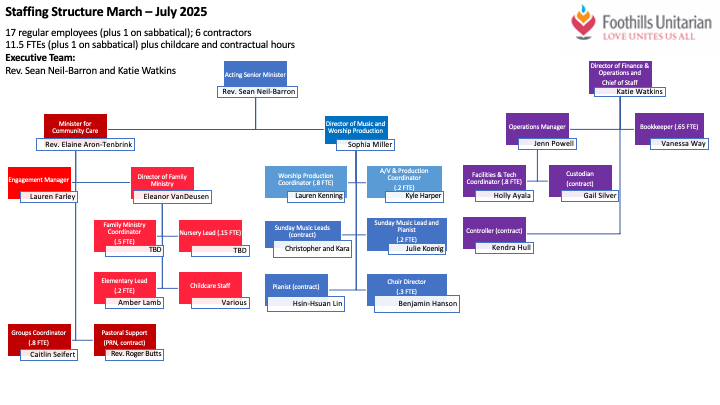
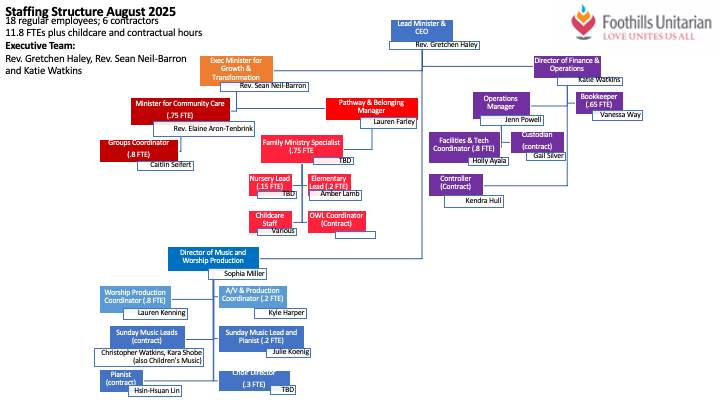
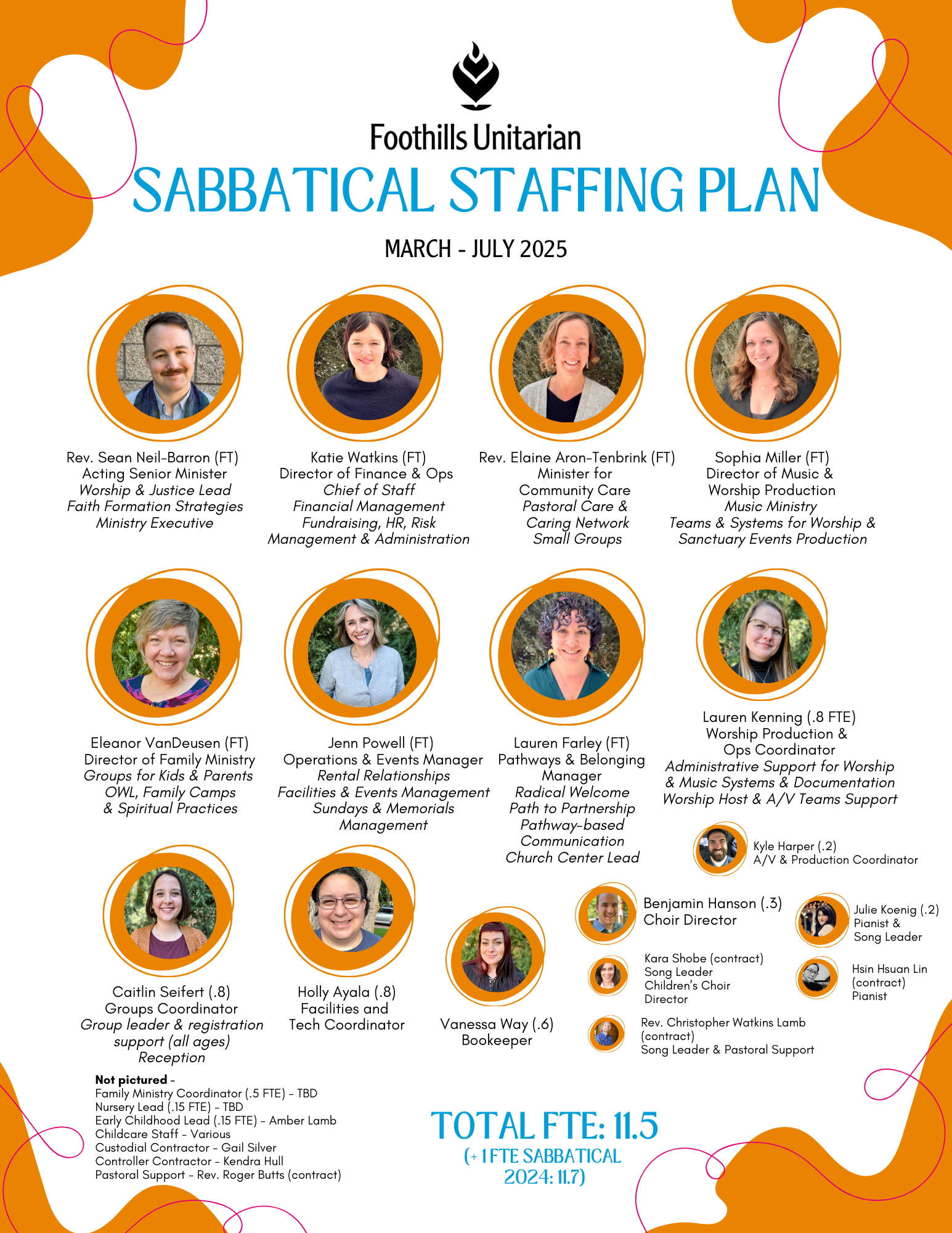
# Staffing Structure
[](https://211134-bookstack.peaknetworks.cloud/uploads/images/gallery/2025-03/vn2UPFIixWKkQO0X-staffing-2025.png)
[](https://211134-bookstack.peaknetworks.cloud/uploads/images/gallery/2025-03/tylNusa4pQAuCz6d-staffing-august-2025.png)
[](https://211134-bookstack.peaknetworks.cloud/uploads/images/gallery/2025-03/lXmf4Mf0V2VUrQ9f-foothills-staffing-2025-10.png)
# Annual Acknowledgement Requirement
Foothills Unitarian requires all employees to acknowledge receipt of the Employee Handbook on an annual basis. This acknowledgement confirms that employees have reviewed the current policies, understand their responsibilities, and agree to abide by the guidelines outlined in the handbook. Any updates or changes will be communicated, and a new acknowledgement will be requested accordingly.
# Appendix A: Glossary and Definitions
- Congregants: Includes all participants, members and regular attendees of the Foothills Unitarian Church.
- Employee: Any person who has been hired by the Foothills Unitarian Church.
- Religious Professional: Generally, this is a designation that includes those who have received advanced training and/or certification in their field, particularly as it relates to Church leadership. In our staff team it includes the ministers, the Director of Faith Formation and the Music Director.
- Member: Any person who has signed the membership book at the Foothills Unitarian Church.
- Head of Staff: The person responsible for supervising the staff team and is either the direct supervisor or the supervisor’s supervisor for every person on staff.
- Senior Minister: The called minister who is designated per Board policy to act as Head of Staff for both paid and volunteer staff.
- Church: The members, friends, community and institution of the Foothills Unitarian Church.
- Clergy: Any professional, fellowshipped ministers employed by the Foothills Unitarian Church.
- Volunteer Staff: Any non-paid person who helps to make things happen at Foothills.
# Appendix B: Staff Covenant
We enter this covenant to cultivate and sustain clarity in how we work together in a nurturing, safe environment characterized by respect and collaboration as a means of accomplishing -- collectively and creatively, with love, joy and humor -- more than we might accomplish on our own. We do this in service to the congregation.
We, the staff of Foothills Unitarian Church, make the following commitments to each other:
- We Commit to Work as a Team
- We Foster Healthy Relationships
- We Model Professionalism
- We Commit to the Vision of Life-Giving Generativity
- We Commit to Work as a Team
- We affirm and trust the passions and gifts each staff person brings to the team and to their individual positions, recognizing one another as whole beings with complex stories and unique personalities.
- We treat one another with kindness, goodness and respect.
- We support each other in fulfilling our varied responsibilities by learning about one another and the work we do, listening and sharing without interruption, being open to feedback and seeing other truths.
- *We are committed to one another’s personal and professional growth.*
- We are clear about boundaries and let others do their jobs, mindful that individual personalities and job realities may dictate differences in how work is done.
- We welcome differences of opinion.
- We align with the core values and commitments of Unitarian Universalism.
- We assume good intentions in one another and in all those with whom we work and serve.
- We Foster Healthy Relationships
- Ask the person to approach the staff member directly and, as needed, help the person get clearer about the issue at hand.
- If *the concern or complaint is related to a potential breach of Church policy then it should be directed to the staff person’s direct supervisor. If appropriate the supervisor will handle in accordance with the Grievance process outlined in the Handbook.*
- If helpful, the staff member will offer to go with the person to speak to the staff member or congregant;
- Otherwise, the matter will be dropped.
- Triangulation is to be avoided.
- Our model for handling complaints or concerns within the staff team or with congregants shall be:
- We deal in issues and behaviors, not personalities.
- We are generous with our gratitude for fellow staff.
- We Model Professionalism
- We value positive attitudes, experimentation, wholeness and grace.
- We maintain boundaries porous enough for constructive and necessary communication to flow while firm enough to remain focused on our respective areas of responsibilities and do not become enmeshed in others’ work.
- When we disagree, we bring forward concerns, listen to understand, and remain open to compromise.
- Regardless of personal feelings, when a decision is made or a direction has been determined, we present a united front to those outside the team and we speak with one voice.
- We commit to holding regular staff meetings and making available to all staff members information resources they need. In turn, we all are responsible for using those resources.
- We uphold confidences and respect sensitive information. We use discretion in communicating outside the team about Church issues, mindful that whatever is communicated will be broadcast.
- We Commit to the Vision of Life-Giving Generativity
- We make the best choices we can to be good stewards of our resources.
- We recognize our own limitations and ask for help before we have reached our limits.
- Faced with limited resources and competing priorities, we will seek clarity and, when necessary, do fewer things, knowing we will do them with greater capacity and success.
- We respect one another’s time off.